


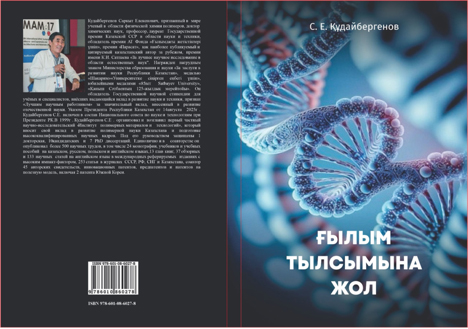
Sarkyt Kudaibergenov. Gylym tylsymyna zhol. Almaty, Center for Operational Press, 2026. 96 p. ISBN 978-601-08-6027-8
The autobiographical book “A Path into the Mysteries of Science” (“Ғылым тылсымына жол”) chronicles the challenging journey of the renowned Kazakh scientist Sarkyt Elekenovich Kudaibergenov – Doctor of Chemical Sciences, Professor, and Laureate of the Kazakh SSR State Prize in Science and Technology – as he discovers the wonders of polymer science. The narrative is presented in chronological order, covering his birth, childhood, school and university years, professional career, and travels abroad, alongside reflections on his mentors, students, colleagues, and friends from his school days, university years, and personal life. The author’s personal perspective and his half-century of service to the beloved field of polymer science may be of interest to a broad readership, and could prove useful to young researchers as well as anyone with an interest in the history of polymer science.
Sarkyt Kudaibergenov. Gibratty Gumyr. Almaty, Kazakh University, 2026. 44th issue. 346 pp. ISBN 978-601-04-7541-0
This volume in the “Gibratty Ghumyr” book series is dedicated to Sarkyt Elekenovich Kudaibergenov, Doctor of Chemical Sciences, Professor, and Laureate of the State Prize of the Kazakh SSR in the field of science and technology. S. E. Kudaibergenov is an internationally recognized scientist in the field of the physical chemistry of polymers. According to a publicly available database compiled by Stanford University researchers, he ranks among the top 2% of the world’s leading scientists in terms of citation impact. Furthermore, the “Web of Science Clarivate Analytics” database identifies him as a global leader in the synthesis and study of synthetic polyampholytes. His research focuses on the development and implementation of specialty polymers for applications in the oil industry, petrochemistry, catalysis, nanotechnology, biotechnology, and medicine. During the years of the Republic of Kazakhstan’s independence, in 1999, S. Kudaibergenov established and took the helm of a private institution, the “Institute of Polymer Materials and Technology,” which contributes to the advancement of polymer science in Kazakhstan and the training of highly qualified scientific personnel. This book is intended for a broad readership.

Dina N. Akbayeva. Catalytic reactions for the preparation of phosphorus- and oxygen-containing compounds. Qazaq Universiti, Almaty, 2024, 178 p. ISBN 978-601-04-6711-8 (https://farabi.university)
The monograph of Akbayeva D.N., doctor of chemical science, associated professor, devoted to liquid-phase oxidative catalysis “Catalytic reactions of phosphorus- and oxygen-containing compounds production” has been published in Russian. It was prepared within the framework of grant financing under the project AR14869287 “Oxidation of aliphatic alcohols by catalase and metal nanoparticles immobilized within macroporous cryogel matrix” (2022-2024), carried out at the Institute of Polymer Materials and Technology.
In the monograph modern approaches to activation and functionalization of elemental (white) phosphorus are considered. The reactivity of coordinated P4 molecule in the form of η1– and η2-ligands is analyzed. A review of works on catalytic reactions for the preparation of phosphorus-containing compounds by oxidative P-O combination reactions of white phosphorus with water, alcohols and amines is made. Catalytic reactions for the preparation of oxygen-containing compounds from octene-1 and aliphatic alcohols carried out in flow and non-flow conventional catalytic laboratory reactors are presented. The ways and possibilities of practical application of the developed catalytic systems in the phosphorus industry, catalysis, organic synthesis, and biotechnology are considered. In the monograph a considerable place is given to the author’s own results.
The book is intended for students, masters, doctoral students and teachers of universities specializing in organometallic chemistry, catalysis, phosphorus and polymer chemistry, petrochemistry.
Contents
Introduction
Chapter 1: Coordination and activation of white phosphorus molecule by transition metal complexes
1.1. Types of white phosphorus activation
1.2. Transition metal complexes containing white phosphorus molecule as η1-ligand
1.3. Reactivity of coordinated white phosphorus molecule as η1-ligand
1.4. Transition metal complexes containing white phosphorus molecule as η2-ligand
1.5. Reactivity of coordinated white phosphorus molecule as η2-ligand
Literature for Chapter 1
Chapter 2. Catalytic reactions for the preparation of phosphorus-containing compounds
2.1. Catalytic oxidation of white phosphorus by peroxides in aqueous and alcoholic solutions
2.2. Catalytic oxidation of white phosphorus with water
2.3. Catalytic oxidation of white phosphorus by oxygen in aqueous, alcoholic, and amine solutions
Literature for Chapter 2
Chapter 3. Catalytic reactions for the production of oxygen-containing compounds
3.1. Role of polymer complexes in oxidative catalysis
3.2. Oxidative catalysis in liquid-phase synthesis involving octene-1
3.3. Oxidative conversion of aliphatic alcohols in the presence of cryogels
Literature for Chapter 3
Conclusion

Sarkyt E. Kudaibergenov. Polyampholytes in Advanced Polymers Science and Emerging Technologies. CRC Press, Boca Raton, London, 2024, 304 p.
Polyampholytes are unique polymers containing acid/base and/or anionic/cationic groups in the main or side chains. Water-soluble and water-swelling polyampholytes exhibit properties that provide broad potential as structural biomaterials, drug delivery and chemo-mechanical systems, biosensors, energy storage devices, supercapacitors, and actuators, among others. This monograph reviews innovative studies in this field over the past two decades with the aim to analyze and systematize the literature in the context of emerging technologies.
• Offers a multidisciplinary perspective covering polyampholytes, polybetaines and polyzwitterions in nanotechnology, biotechnology, medicine, catalysis, environment protection, and oil industry applications.
• Demonstrates a wide range of applications for these materials, with enough depth to provide critical fundamental knowledge for new researchers in the field.
• Discusses polyampholyte-protected and gel-immobilized metal nanoparticles and enzymes that catalyze reactions of hydrolysis, decomposition, hydrogenation, and oxidation of various substrates in batch-type and continuous-flow-type reactors.
• Highlights remaining persistent challenges in the development and application of these materials.
The book will appeal to a readership that conducts materials research for biomedical, water treatment, and environmental remediation applications.
Table of Contents
1. Introduction
2. Water-Soluble Polyampholytes
3. Hydrophobically-Modified Polyampholytes (HMPA)
4.Nanogels, Microgels and Macroporous Gels of Polyampholytes
5. Macromolecular Complexes of Polyampholytes
6. Polyampholytes in Biotechnology and Medicine
7. Polyampholytes in Catalysis
8. Application of Polyampholytes in Emerging Technologies
9. Conclusions

Monographs and textbooks
- Sarkyt E. Kudaibergenov. Polyampholytes: Past, Present, Perspectives. Almaty, 2021, 222 p.
- Bekturov E. A., Kudaibergenov S. E., Ibraeva Zh. E. Polymers in nanotechnology (in Russian). Almaty, 2019, 388 p.
- Multifunctional polymers in drilling, production and transportation of oil and processing of petroleum products (in Russian) //Collective monograph. – Almaty, Printing house: “Center for Operational Printing”, 2018. – 188 p.; 513 references, 104 figures, 37 tables. ISBN 978-601-323-095-5.
- E. A. Bekturov, S. E. Kudaibergenov. A short course in the physics and chemistry of polymers (In Russian). 2017, Almaty, ed. “Ulagat” KazNPU named after Abai, 223 p.
- Ibraeva Zh. E., Kudaibergenov S.E., Bekturov E. A. Stabilization of metal nanoparticles by hydrophilic polymers (in Russian). Lambert Academic Publishing, Saarbrücken, Germany, 2013. – 367 p.
- S. E. Kudaibergenov, Zh. E. Ibraeva, S. K. Kabdrakhmanova, B. Kh. Musabaeva, G. S. Tatykhanova. Composite polymer materials and technologies on their basis (in Russian). Semey, Tengri Publishing House, 2013, 216 p.
- S. E. Kudaibergenov, Zh. E. Ibraeva, M. G. Yashkarova, E. A. Bekturov. Composite hydrogel materials (in Russian). Semey, 2011. 148 p.
- E. A. Bekturov, S. E. Kudaibergenov, A. K. Zharmagambetova, R. M. Iskakov, Zh. E.Ibraeva, S. N. Shmakov. Polymer-protected metal nanoparticles (in Russian). Almaty, 2010, 274 p.
- S. E. Kudaibergenov, L. A. Bimendina, M. G. Yashkarova, L. K. Orazzhanova, V. B. Sigitov. Synthesis, properties and application of new polymer betaines based on aminocrotonates (in Russian), ed.SSU im. Shakarima, Semipalatinsk, 2006,110 p.
- L. A. Bimendina, M. G. Yashkarova, S. E. Kudaibergenov, E. A. Bekturov, Polymer complexes (preparation, properties, application) (in Russian), SSU. Shakarima, Semipalatinsk, 2003, 285 p.
- E. Kudaibergenov. Polyampholytes: Synthesis, Characterization and Application, Kluwer Academic/Plenum Publishers, New York, Boston, Dordrecht, Tokyo, Moscow, 2002, 220 p.
Book Chapters
- Dolya, S. Kudaibergenov. Catalysis by Thermoresponsive Polymers. Chapter 19 in book «Temperature-Responsive Polymers: Chemistry, Properties and Applications» (Edited by Vitaliy Khutoryanskiy and Theoni Georgiou), 2018 (to be published).
- Kudaibergenov, G. Tatykhanova, N. Bakranov, R. Tursunova. Layer-by-Layer Thin Films and Coatings Containing Metal Nanoparticles in Catalysis. Chapter 8 in Book “Thin Film Processes – Artifacts on Surface Phenomena and Technological Facets”, (Ed. by J. Thirumalai), InTech, 2017, P. 147-164.
- D. Moniruddin, S. Kudaibergenov, Nю Nuraje. Hierarchical Nanoheterostructures for Water Splitting.// Chapter 7 in book Green Photo-active Nanomaterials Sustainable Energy and Environmental Remediation. The Royal Society of Chemistry, 2016. P. 142-167.
- Kudaibergenov, Zh. Ibrayeva, M. Yashkarova, S. Kabdrakhmanova, G. Tatykhanova. Chapter 1. Composite Hydrogel Materials. In book: Advanced Separations by Specialized Sorbents. -New York: CRC Press, 2014. Р.1-37.
- Kudaibergenov, G. Tatykhanova, Zh. Ibraeva, Immobilization and controlled release of bioactive substances from stimuli-responsive hydrogels. Biodefence. NATO Science for Peace and Security Series-A: Chemistry and Biology. Chapter 19. Springer Science+Business Media B.V. 2011, p. 179-188.
- E. Kudaibergenov, L.A. Bimendina, M.G. Yashkarova, Prevention of soil migration and capturing of radionuclides by interpolymer complexes. Chapter 11. In: Hydrogen Bonded Interpolymer Complexes: Formation, Structure and Applications. V.V.Khutoryanskiy, G. Staikos Eds. 2009. Chapter 11. –P. 301-322.
- E. Kudaibergenov, A.G. Didukh, S.B. Moldakarimov. Structure of Polyampholyte Gels and Their Behavior with Respect to Applied External DC Electric Field. Chapter 10 in book “ACS Symposium Series 833 Polymer Gels. Fundamentals and Applications“, Edited by H.B. Bohidar, P. Dubin and Y. Osada, ACS Washington DC 2002, pp.149-162.
- Bimendina L.A., Zhumadilova G.T., Kudaibergenov S.E., Phase Transitions in Interpolymer Complexes of some Linear and Cross-Linked Polymers. Chapter 9 in book “ACS Symposium Series 833 Polymer Gels. Fundamentals and Applications“, Edited by H.B.Bohidar, P.Dubin and Y.Osada, ACS Washington DC 2002, pp. 137-148.
- G. Didukh, G.Sh. Makysh, L.A. Bimendina, S.E. Kudaibergenov, Bovine serum albumin complexation with some polyampholytes. Advanced Macromolecular and Supramolecular Materials and Processes. Kluwer Academic/Plenum Publishers. 2003, Ch.12, p. 265-275.
- E. Kudaibergenov, L.A. Bimendina, G.T. Zhumadilova, Design, structure and behavior of interpolymer complex membranes. Advanced Macromolecular and Supramolecular Materials and Processes. Kluwer Academic/Plenum Publishers. 2003, Ch.10, p. 149-162.
- Kudaibergenov S.E. Solutions, Complexes and Gels of Amphoteric Polyelectrolytes, In: Proceedings of Yamada Conference L “Polyelectrolytes”, (I.Noda, E.Kokufuta Eds.), Japan, 1999. P.259-262.